

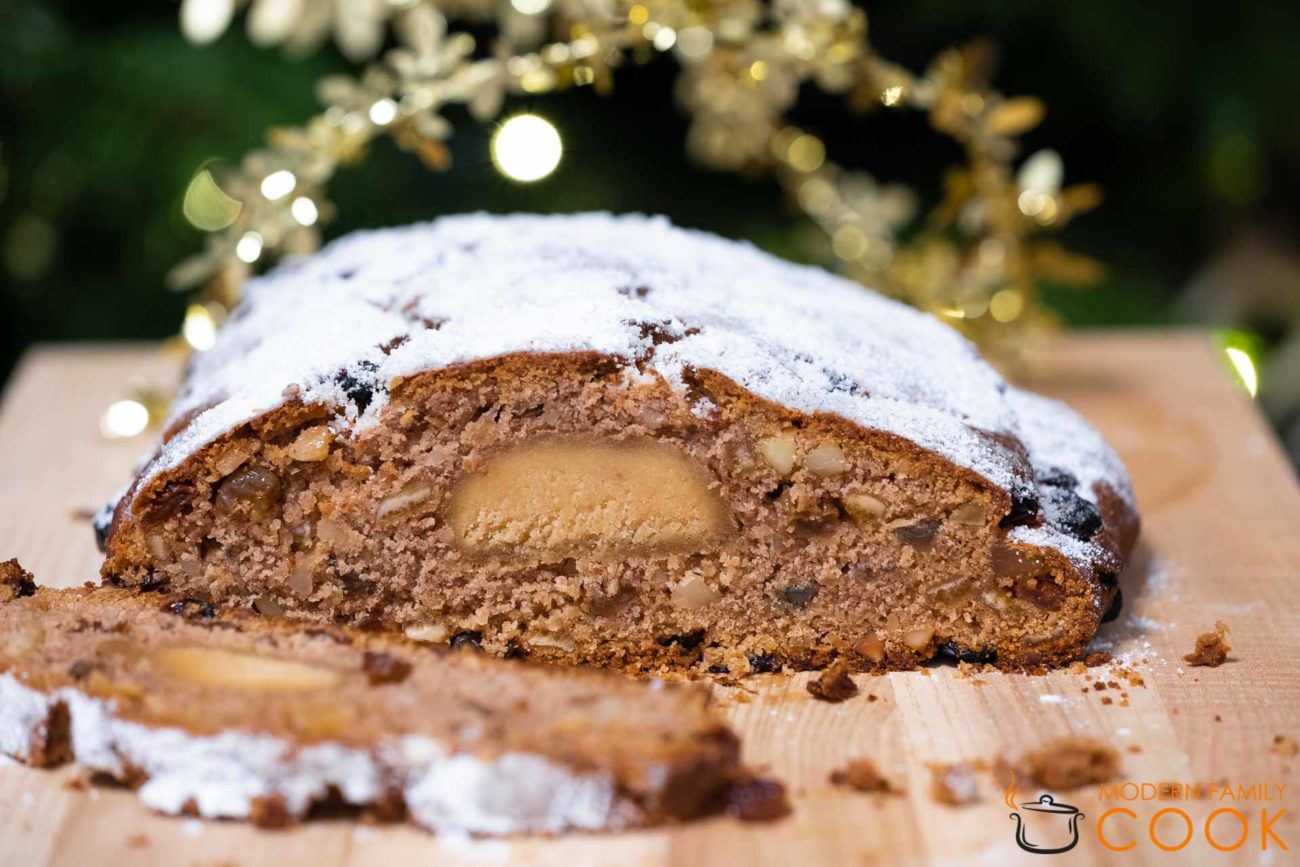





Ingredients
-
Dry ingredients:
-
200 g of Whole-grain gluten-free flour blend
-
80 g of Corn starch
-
100 g of Almond grounded
-
20 g of Psyllium husk powder
-
11 g Dry yeast
-
60 g of Sugar white
-
1/2 tsp. of Salt
-
1/2 tbsp. of Lemon zest
-
65 g of GheeOr coconut oil, softened
-
Wet ingredients:
-
250 ml of Coconut milk
-
1 Egg(s)
-
20 g of Date syrupOr Agave syrup/honey
-
Filling:
-
150 g of Raisins
-
200 ml of WaterOr apple juice
-
50 ml of Rum
-
60 g of Citronat
-
60 g of Candied orange peel
-
100 g of AlmondWhole almonds
-
100 г MarzipanOptionally
-
Dusting:
-
50 g of Ghee
-
Caster sugar
Directions

Stollen is a traditional German Christmas bread–cake–loaf, also popular in Austria. The name fully matches the German word Stollen, which means “tunnel” or “mining passage,” although there is no single definitive explanation of how the pastry’s name relates to mining.
The loaf is traditionally elongated and oval, generously dusted with powdered sugar on top, symbolizing the Baby Jesus wrapped in white swaddling cloth.
The earliest mentions of Stollen date back to the 14th century in Germany, where it was baked during the Christmas season as a simple bread made of flour, water, and yeast, since the Church prohibited the use of milk and butter during fasting.
In 1491, Pope Innocent VIII issued the so-called Butterbrief (“butter letter”), which allowed the use of butter in Stollen dough in Saxony — a turning point that transformed Stollen into a rich festive bread. Since then the recipes have evolved, incorporating candied fruit, nuts, marzipan, and spices.
As with any traditional and popular dish, Stollen exists in countless recipe variations. I based mine on the most celebrated version, considered the gold standard of traditional baking — the Dresden Stollen. Trying to stay as close as possible to the classic technique, I developed a gluten-free version, which I bake every year.
Dresden Stollen is the most famous type of Stollen in Germany. It has a protected geographical indication (PGI), meaning it may be called “Dresden Stollen” only if it is produced in a specific region around Dresden and meets strict quality standards.
This variety is known for its high content of butter, dried fruit, candied peel, and nuts (most often almonds). Traditionally, the baked loaf is brushed generously with melted butter and heavily coated with a thick layer of powdered sugar. Its shape is dense, elongated, and oval. Marzipan is often added inside, although this is not strictly mandatory. We will follow that tradition as well!
The recipe uses a gluten-free whole-grain flour blend, but you may substitute it with a mixture of rice and buckwheat flour in a 1:1 ratio.
Enjoy!
Today's visits: 1.
Steps
|
1
Done
|
Soak the raisins in room-temperature water with rum for at least 1 hour. Then drain the liquid and let the raisins dry thoroughly. Coarsely chop the whole almonds. |
|
2
Done
|
In one bowl, whisk together all dry ingredients except the ghee. In another bowl, beat the egg with a fork until smooth, add the date syrup, lemon zest, and coconut milk. Mix until combined. |
|
3
Done
|
Transfer the dough onto a silicone rolling mat. Knead it by hand 3–4 times until it forms a smooth ball. Flatten the ball gently, place the raisins, candied fruit, and chopped almonds in the center, fold the dough over like a pouch, and knead a few more times until the filling is evenly distributed. Shape into a ball again. |
|
4
Done
|
Flatten the dough into a disk about 2–5 cm thick; the thicker the disk, the higher and more compact the final Stollen. Place a log of marzipan in the center, fold the dough in half, and shape it into a traditional Stollen. Let it rest at room temperature for 1–1.5 hours. |
|
5
Done
|
Preheat the oven to 170°C (338°F). Bake the Stollen for 60 minutes. If it browns too quickly near the end, cover it loosely with foil. |
|
6
Done
|
Melt the ghee and prepare the powdered sugar with a fine sieve. |
|
7
Done
|
Let the Stollen cool completely. Once cooled, wrap it tightly in plastic wrap and let it rest in a cool place (not the refrigerator) for 12 hours. Then slice and enjoy. |